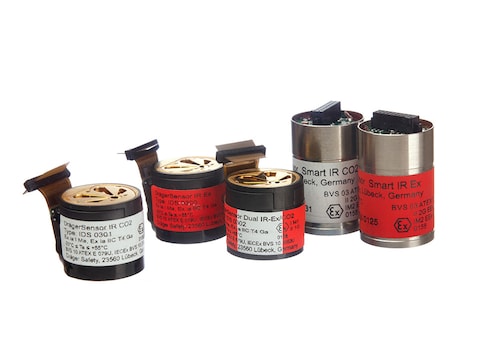
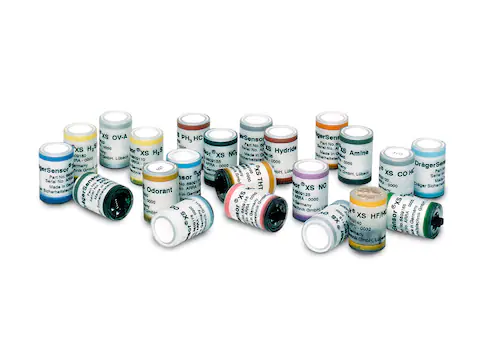
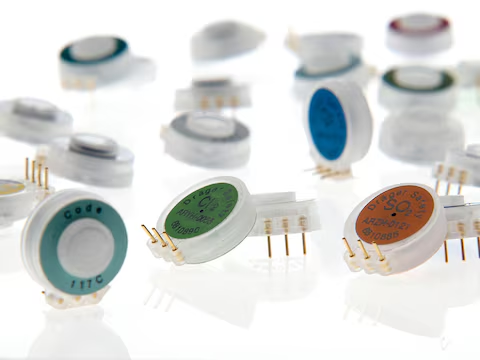
Our own design
We develop these sensors with our own engineering knowledge. This way we can assure quality and accurate measurement. This allows them to be utilized to the fullest in combination with our in-house developed Dräger gas detectors.

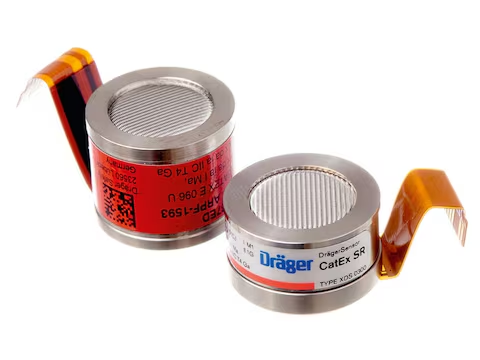
We develop these sensors with our own engineering knowledge. This way we can assure quality and accurate measurement. This allows them to be utilized to the fullest in combination with our in-house developed Dräger gas detectors.
We develop these sensors with our own engineering knowledge. This way we can assure quality and accurate measurement. This allows them to be utilized to the fullest in combination with our in-house developed Dräger gas detectors.
The CatEx SR (SR = shock resistant) DrägerSensor is characterised by its particular shock resistance. A fall from great height that exceeds the standard requirements has no effect on the sensor signal. The usual adjustment of the zero point and sensi tivity required after an impact can be omitted, which saves time and effort. Adjustment is only required if a different fresh air display than 0 is shown after impact from high falling heights.
Hydrogen sulphide and silicone are known catalytic poisons that may be present in environments with explosive gas. Thanks to an improved pellistor composition, the sensors are highly resistant to poisoning from these substances. The high resistance t o poisoning leads to exceptional long-term stability, thus ensuring low operating costs.
Unknown gas hazards and higher hydrocarbons pose a particular challenge for the sensitivity display of catalytic sensors. The new CatEx DrägerSensors are particularly sensitive. The detection of all hydrocarbons (from methane to nonane) has been cert ified in a measurement performance certification for the Dräger X-am 2600/2800/5000/5800 and X-am 3500/8000 device series. Nonane-suitable pump adapter required.
Dräger's catalytic sensors are suitable for providing warning of known and unknown flammable gas hazards. The sensors provide the option of setting the device for a variety of different combustible gases or vapours, including hydrogen. If several fla mmable substances to which the sensor reacts differently must be measured, a substitute gas adjustment is recommended. Different test gases can be used for the adjustment using a simple device function. The necessary calculations are performed by the gas measuring device. Manual conversions are not necessary.
Rapid warning for explosive gases and vapours is vital. Our CatEx sensors' fast response times minimise the timespan between danger and warning.
With the DrägerSensor CatEx SR, fresh air adjustment can be performed after a maximum of only 60 seconds after switching on the device. This saves valuable time and lets you perform a fresh air adjustment shortly before the shift, for example.
Our catalytic sensors are suitable for measurements in the lower explosion limit range. For methane, measurement up to 100 vol% is also possible. The X-am 5800 or X-am 8000 features the option to automatically switch the measuring ranges, making it ea sier to read results when monitoring for high methane concentrations: if the CatEx sensor measures values above 100% LEL, the display switches to the range of 0 to 100 vol%.